

2011-07-27

2011-07-20
Cooking with cow dung, cleaning with our tongues
 |
| The narrow path to Begz's ger |
We milked his cows, played games with the kids, cooked hushuur dumplings, helped take down his relative's ger, and even made a stove out of cow dung! Their lives revolve around their cows. Their diet consists of mainly dairy products and they use cow dung for heating. Begz says they choose not to use coal because it pollutes the air. They dry the cow dung for one year before using them.
 |
| Manujin and Todo drying cow dung |
 | |
| Begz and Yoshi milking a cow |
 |
| Playing anklebone games with Gaadmaa and Mungulun |
 |
| Me and Manujin playing outside |
 |
| Teaching them how to play 'hanafuda' and 'Jamaica' |
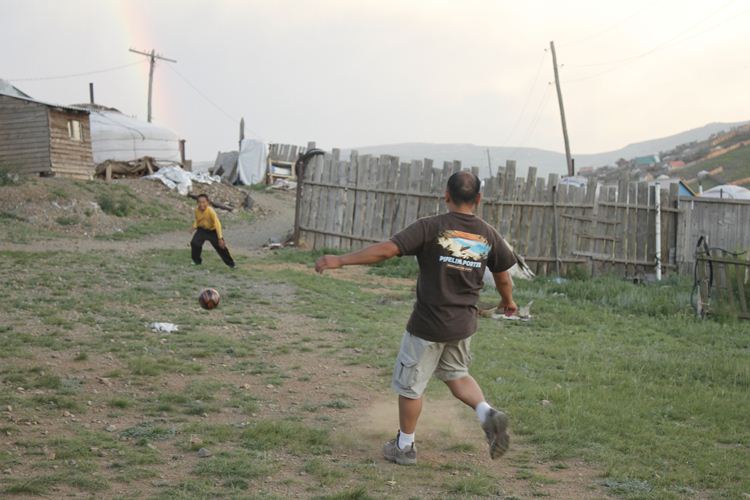 |
| Todo and Yoshi playing soccer |


Cooking hushuur dumplings
 |
| Taking apart a ger |


 |
| Begz and Yoshi making a stove out of cow dung |

 |
| Eej cooking |
The way they clean their bowls is otherworldly. When we finished our food, Begz said, "Okay, now lick your bowls." I thought he was joking, but when he started to lick his bowl, my mouth dropped. And with a big smile on his face, he explained, "We clean our bowls with our tongue. It's the traditional way. We save water and it's good exercise for the tongue! Also, we do this to show our thanks to Eej for cooking this wonderful meal." "I see..." I said, but seeing Begz lick his plate made me realize how much I was conditioned not to do this. It felt completely inappropriate. I didn't care so much about exercising my tongue, but I wanted to show Eej my thanks so I cleaned my bowl the Mongolian way! On our last day, Eej told us we were the best lickers they've had. They've hosted over 100 couchsurfers so I guess it's a compliment! I should include that as one of my new talents: plate licking.

Spending three nights with Begz's family opened my eyes to the ger lifestyle. In the round ger, everything circulates. There are no walls; everything is connected. The family is one. What I learned from this experience is that a simple life is a happy life. So, why is it so difficult to be simple?


2011-07-19
Naadam Festival Day 2
On Day 2, we went to see the horse race in Khui Doloon Khutag, just outside of Ulaanbaatar. Stuart, an Australian guy we met at the guest house, offered us a ride with him and his guide. We were lucky we didn't have to bother with public transportation but Stuart's driver was a crazy driver! He was driving into on-coming traffic and through the grasslands. It was quite a ride!
Mongolian horse race takes place on open grasslands with no set tracks. The horses are aged 2-5 and the jockeys, believe it or not, are children aged 5-12. Seeing these young boys race their horses through the grasslands was incredible.


The locals believe that putting the racehorse's sweat on your forehead brings good luck, so they chase after the horses.
Mongolian horse race takes place on open grasslands with no set tracks. The horses are aged 2-5 and the jockeys, believe it or not, are children aged 5-12. Seeing these young boys race their horses through the grasslands was incredible.


The locals believe that putting the racehorse's sweat on your forehead brings good luck, so they chase after the horses.
Naadam Festival Day 1
The biggest festival in Mongolia, the Naadam Festival, is held annually on July 11-12th. The entire nation is in festive mood and the streets are filled with locals wearing traditional costumes. 'Naadam' means 'games' in Mongolian. Four games are competed during the festival: Mongolian wrestling, archery, horse racing, and anklebone throwing.
Japanese sumo and Mongolian wrestling have some similarities, but one big difference is that Japanese sumo is competed on a dohyo or ring, while Mongolian wrestling has no ring. In recent years, many Mongolian wrestlers have come to Japan to compete in Japanese sumo. The current and previous yokozuna (highest ranked sumo wrestler) are both Mongolian.
The opening ceremony was held in the morning on July 11th. Two full hours of dance and music performances. It was like watching the opening ceremony for the Olympics!


Japanese sumo and Mongolian wrestling have some similarities, but one big difference is that Japanese sumo is competed on a dohyo or ring, while Mongolian wrestling has no ring. In recent years, many Mongolian wrestlers have come to Japan to compete in Japanese sumo. The current and previous yokozuna (highest ranked sumo wrestler) are both Mongolian.
The opening ceremony was held in the morning on July 11th. Two full hours of dance and music performances. It was like watching the opening ceremony for the Olympics!


2011-07-13
5 hours at the border crossing
So far, we've crossed seven borders. Entering Russia was no problem. Immigration check was done on the train from Helsinki, it only took 10 minutes, and there was no hassle. The border crossing from Russia to Mongolia, however, was another story.
Our train from Irkutsk to Ulaanbaator departed at 4:50AM. 8 hours later, at around 1:30PM, we arrived at the Russian border, the town of Naushki. The immigration officer entered our cabin, said "I take passport" and disappeared with our passports. He didn't return for three hours! And after a not-so-thorough cabin check, we finally got our passports back. Phew! Border crossings can be so stressful.


The next stop was the Monglian border. It took about 45 minutes to actually cross the border. When we reached the Mongolian border, the town of Sukhbaator, we had our passports taken again and our cabin checked. While we waited, we ate our dinner (instant noodles and bread) and chatted with our Mongolian cabinmates, Tegshee and his father. The language barrier made it difficult but they were very very friendly.
The first difference we noticed between Mongolians and Russians is that Mongolians smile. Russians don't smile much and even the children have stern looks on their faces. We asked a Russian guy we met in Tomsk about this and he warned us, "If you smile at a Russian, they'll think you're laughing at them and get angry. Don't smile at them."
Our train from Irkutsk to Ulaanbaator departed at 4:50AM. 8 hours later, at around 1:30PM, we arrived at the Russian border, the town of Naushki. The immigration officer entered our cabin, said "I take passport" and disappeared with our passports. He didn't return for three hours! And after a not-so-thorough cabin check, we finally got our passports back. Phew! Border crossings can be so stressful.


The next stop was the Monglian border. It took about 45 minutes to actually cross the border. When we reached the Mongolian border, the town of Sukhbaator, we had our passports taken again and our cabin checked. While we waited, we ate our dinner (instant noodles and bread) and chatted with our Mongolian cabinmates, Tegshee and his father. The language barrier made it difficult but they were very very friendly.
 |
| Tegshee and Yoshi |
 |
| View from train: Northern Mongolia |
July 9th Dinner

Menu
Minestrone
Ingredients
100g macaroni
30g green peas (dried)
1/2 carrot
2 tomatoes
1 onion
1 potato
2 bay leaves
oregano
salt
Instant food: none

July 8th Dinner

Menu
Pork fried rice
Eggplant and pork stir fry
Ingredients
Pork fried rice
1.5 cups rice
2 eggs
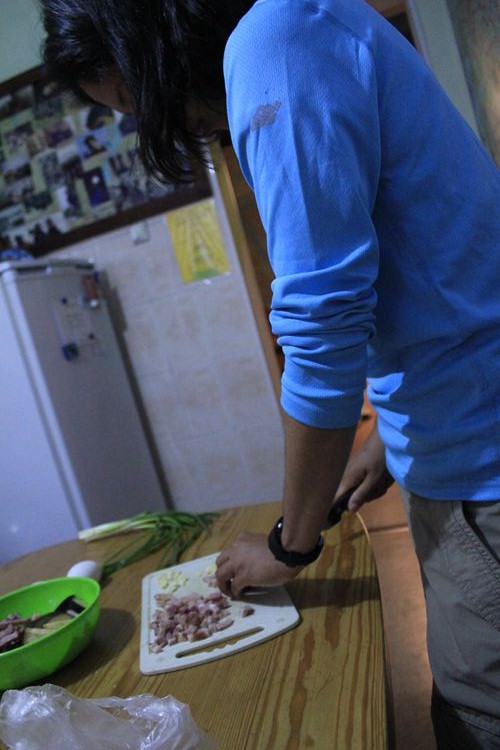
2 scallions
80g pork
1/2 pack fish broth
soy sauce 1/3 pack
salt
Eggplant and pork stir fry
1 eggplant (L)
3 scallions
120g pork
1/2 pack fish broth
2/3 pack soy sauce
salt
Instant food: none


2011-07-09

cultural crossroads
Irkutsk is an interesting city at the crossroads of Russian and Mongolian cultures. I can feel we're slowly getting closer to Asia. We went to eat at a local restaurant yesterday and we were so happy to see dumplings on the menu! Pozi, as they are called, are steamed meat dumplings from Buryatia. Fresh pozi with black tea and milk is the Buryat way to eat them. Absolutely delicious!
 |
| pozi, dumpling soup, and crepes |
 | ||
| cheese-sellers at the market |
 | ||
| we bought two eggs and the lady laughed at us |
 | |
| Russian cookies taste really good! |
 |
| wedding by Lake Baikal -- the deepest lake in the world |
2011-07-08
Trans Siberian Diary (cont.)
July 6th 10AM
Today, we hopped off the Trans Siberian Railway and spent the day in Tomsk. Tomsk is a university city known for it's beautiful traditional Siberian 'wooden lace' architecture.


July 7th, Noon
Our train from Tomsk to Irkutsk has a much more retro feel to it than our first train. We're sharing our cabin with two Russian guys. Vladimir is a student at Tomsk State University, the first university in Siberia. He's on his way home to Ulan Ude, the capital of the Republic of Buryatia. Ulan Ude is home to many Buryats -- the largest indigenous group in Russia. It's going to take Vladimir three days to get home. Can you imagine? From Vassar, it only took me two hours on the Metro-North! I think he's really excited about seeing his family. He keeps saying, "Two more days, I home. One more day, I home." It's really cute!
The other guy, Alexander, well, he doesn't speak a word of English so it's hard to get to know him. I wish I spoke some Russian. The only Russian words I know are 'da' (yes), 'nyet' (no), and 'spasiba' (thank you). I should probably try to learn some useful phrases.
A little bit of history about the Trans Siberian Railway. Construction of the railway began in the late 19th century, mainly to foster industrial development in Siberia. And after more than 10 years, the railway was completed allowing millions of people to migrate to Siberia.
Now there are three lines that branch out of the main Trans Siberian line: the Trans Manchurian, the Trans Mongolian, and the Turkestan Siberian. We will be traveling on the Trans Mongolian line to Ulaanbaator and then to China. Apparently, there are plans to build a Trans Korean line but tensions between North and South Korea is delaying the process. A train trip through Eastern Russia, Harbin, and Pyongyang sounds tempting!
Today, we hopped off the Trans Siberian Railway and spent the day in Tomsk. Tomsk is a university city known for it's beautiful traditional Siberian 'wooden lace' architecture.


July 7th, Noon
Our train from Tomsk to Irkutsk has a much more retro feel to it than our first train. We're sharing our cabin with two Russian guys. Vladimir is a student at Tomsk State University, the first university in Siberia. He's on his way home to Ulan Ude, the capital of the Republic of Buryatia. Ulan Ude is home to many Buryats -- the largest indigenous group in Russia. It's going to take Vladimir three days to get home. Can you imagine? From Vassar, it only took me two hours on the Metro-North! I think he's really excited about seeing his family. He keeps saying, "Two more days, I home. One more day, I home." It's really cute!
The other guy, Alexander, well, he doesn't speak a word of English so it's hard to get to know him. I wish I spoke some Russian. The only Russian words I know are 'da' (yes), 'nyet' (no), and 'spasiba' (thank you). I should probably try to learn some useful phrases.
 |
| Vladimir in our cabin |
Now there are three lines that branch out of the main Trans Siberian line: the Trans Manchurian, the Trans Mongolian, and the Turkestan Siberian. We will be traveling on the Trans Mongolian line to Ulaanbaator and then to China. Apparently, there are plans to build a Trans Korean line but tensions between North and South Korea is delaying the process. A train trip through Eastern Russia, Harbin, and Pyongyang sounds tempting!
Subscribe to:
Posts (Atom)